
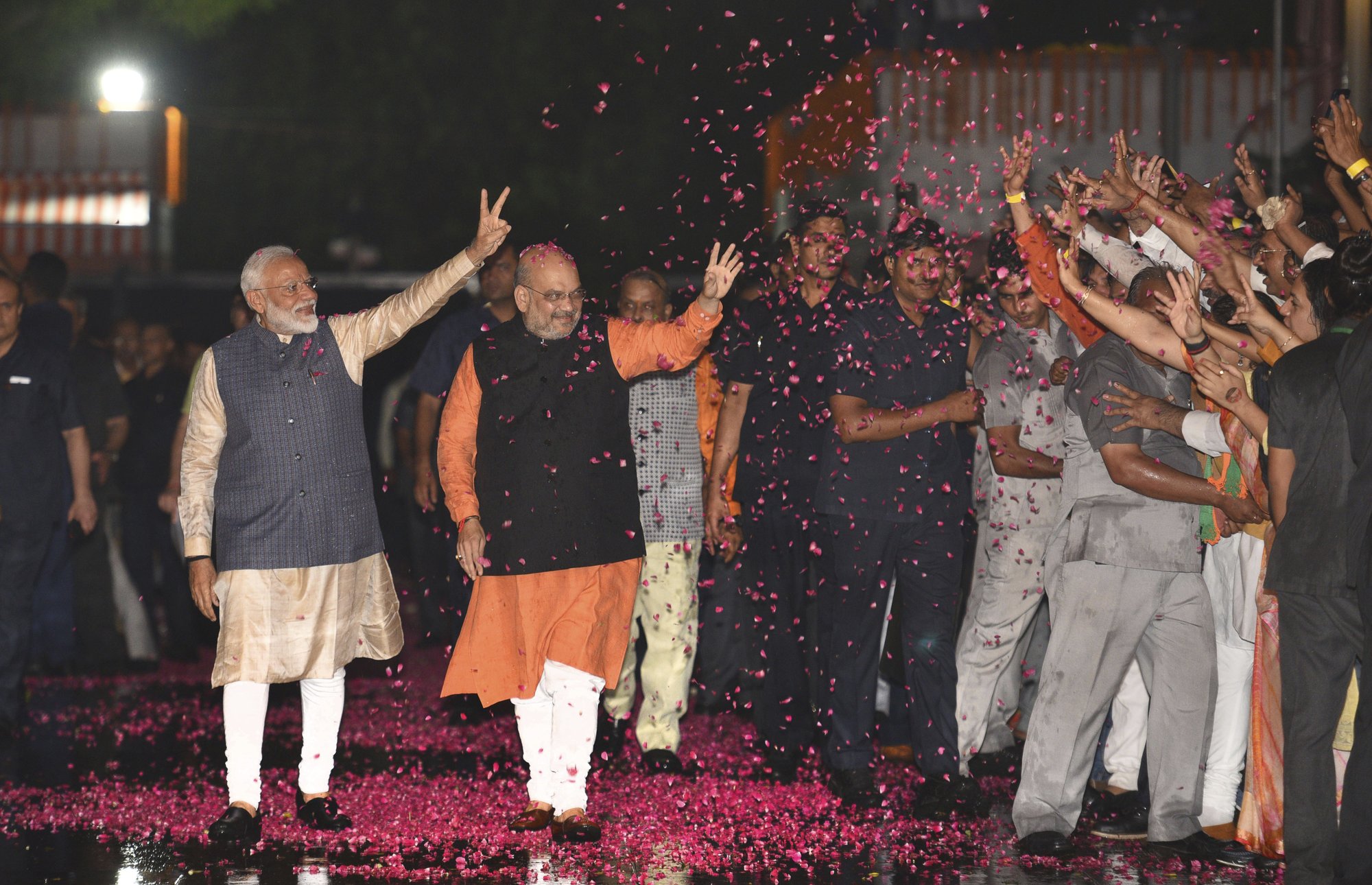
Charismatic but polarizing Prime Minister Narendra Modi surged to a landslide victory in Indian elections, propelling his Hindu nationalist party to back-to-back majorities in parliament for the first time in decades.
With most of the estimated 600 million votes counted by early Friday, Modi’s reelection mirrored a trend of right-wing populists sweeping to victory, from the United States to Brazil to Italy, often by promoting a tough security stance and protectionist trade policies. India’s elections were seen as a referendum on Modi’s Hindu-first politics, which critics say have bred intolerance, as well as his muscular stance on archrival Pakistan, with whom India nearly went to war earlier this year.
“India wins yet again,” Modi exulted in a tweet.
Election Commission data by Friday morning showed Modi’s Bharatiya Janata Party winning 287 out of the 525 seats in the Lok Sabha, India’s lower house of Parliament, well beyond the simple majority to form a government. Top rival Indian National Congress won 50 seats but lost one held by party president Rahul Gandhi, the scion of modern India’s most powerful political dynasty.
The All India Trinamool Congress led by West Bengal chief minister Mamata Banerjee won 19 seats. Results were not in for 42 seats, and the final tally was not expected until later Friday.
Addressing thousands of party workers celebrating the outcome, Modi urged the world to “recognize India’s democratic power.” He attributed the party’s showing to his policies aimed at improving the lot of the nation’s poor, including free medical insurance, relief for distressed farmers and a highly popular program to build 100 million toilets in a nation where basic sanitation is limited.
The election victory was a resounding endorsement of the 68-year-old Modi, whose economic reforms have had mixed results but whose background as a social underdog from a lower-caste Hindu family clearly inspired some in India’s highly stratified society, appealing to tens of millions of Indians seeking upward mobility. Critics have said his Hindu-first platform risks exacerbating social tensions in the country of 1.3 billion people.
Since Modi led the Bharatiya Janata Party to power in 2014, Hindu mobs have lynched dozens of Muslims and lower-caste Dalits for consuming or slaughtering cows, which Hindus consider sacred.
Modi has largely shown complacency toward violence and discrimination against minorities, and to rhetoric like that of his party’s president, who called mainly Muslim Bangladeshi migrants to India “termites,” or one of BJP’s candidates for parliament, who described peace activist Mahatma Gandhi’s assassin as a “patriot.” Activists, lawyers, journalists and academics have been harassed and even prosecuted under anti-terrorism and anti-sedition laws that Human Rights Watch calls draconian.
But on the campaign trail, Modi seized on his personal narrative, presenting himself as a self-made man with the confidence to cut red tape and unleash India’s economic potential, and labeling Congress party president Rahul Gandhi as an out-of-touch elite. This resonated in India, where an anti-corruption movement helped lead to the ouster of Congress partly for the perceived excesses of the Gandhi family, and for the bloated and inefficient bureaucracies Congress ran as the ruling party for nearly a half-century after independence.
Gandhi conceded defeat for his own parliamentary seat to his BJP rival in Amethi, a constituency in Uttar Pradesh state that had been a Congress bastion. But candidates are allowed to run in more than one constituency, and Gandhi was leading the race for a constituency in the southern state of Kerala.
Before the results were complete, President Donald Trump, Chinese President Xi Zinping, Israeli Prime Minister Benjamin Netanyahu and others were rushing to congratulate Modi.
The elections, so daunting an exercise they are phased over six weeks, were a testimony to the vibrancy of the world’s largest democracy just 72 years since India won independence from British colonial rule.
Voters expressed confidence that Modi could jumpstart India’s stalling economy, despite his poor first-term record and failure to deliver on his pledge to create jobs.
The BJP harnessed social media, including Twitter, where Modi has 47.4 million followers, and WhatsApp to reach out to millions of supporters.
Modi also capitalized on a suicide bombing in Kashmir in February that killed 40 Indian soldiers. India retaliated with airstrikes at alleged terrorist training camps in Pakistan, fanning the flames of nationalism and helping hold voters’ attention.
As votes were being counted, Pakistan’s military said it successfully test-fired a long-range ballistic missile capable of carrying a nuclear warhead.
Tensions with Pakistan “gave him the narrative he needed to counter all these allegations of non-performance, unemployment and rural distress. It reenergized him and enabled him to reclaim his image as a strong leader India needs at this juncture,” political commentator Arti Jerath said.
The BJP’s performance “is absolutely stunning. Modi is the predominant leader in India today. He has pushed everybody else aside. Nobody in the opposition is a match for him,” Jerath added.
Trends in the election data suggest that BJP’s strategy of aggressively campaigning in eastern India worked, with the party breaking into the citadels of Trinamool Congress Party in West Bengal state and the Biju Janata Dal in Odisha state.
The biggest losers appear to be the Communists who ruled West Bengal state for 34 years until they were ousted by Mamata Banerjee’s Trinamool Congress Party in 2011. Coalition partners of the Congress-led government in New Delhi between 2004 and 2008, the Communist Party of India (Marxist) was leading in only three constituencies and the Communist Party of India in two constituencies.
Outside BJP headquarters in New Delhi, hundreds of people cheered and shouted party slogans, lifting cardboard cutouts of Modi and BJP President Amit Shah into the air as other people played drums and set off fireworks.
Mohit Sharma, a 29-year-old who runs a bathroom fittings business, said India had never had a prime minister like Modi.
“In the past, when leaders after they won elections, they sat in air-conditioned rooms and they never reached out to people, but Modi was never like that. He was always connected to the people through social media,” Sharma said.
Source – AP News


